
A shared view of the building, without replacing existing systems.
The BOS forms the building’s transverse digital layer. It connects technical, real-estate and business systems, organises their data in a common ontology and makes it available to applications in a coherent context. Each tool keeps its role.
The BOS transforms instrumented buildings into a source of created value.
By leveraging technical, real-estate, energy and usage data in a single source of truth, it enables new services, customised control cockpits and a real-time digital twin to drive performance.
By giving the building an operating system, the BOS paves the way for a new generation of smart building applications and a sustainable return on investment.
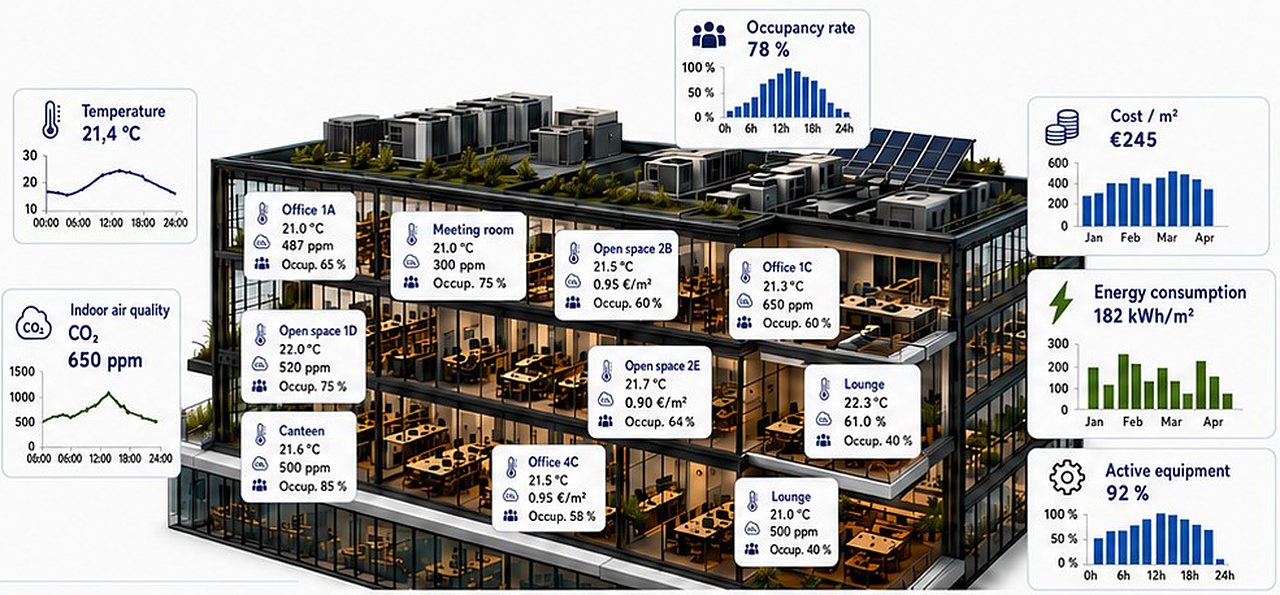
The BOS links existing tools, contextualises their data and enables applications to share the same understanding of the building.
Five building blocks that set the BOS apart from simple data centralisation.
A common ontology to describe the building
Building systems do not naturally speak the same language: equipment may have one reference in the CMMS, another code in the BMS and another designation in the technical documentation.
The ontology provides a common vocabulary and business rules: equipment located in a zone, serving a zone, belonging to a technical system, covered by a contract, with documentation and possibly affecting certain risks. This prevents each application from rebuilding its own representation of the building.
Isolated data becomes contextualised information
A value or an alarm is rarely enough to decide. Its meaning depends on the location, time, equipment, user and recent events.
The BOS can link a temperature to its actual setpoint, the occupancy level, the ventilation system, outside weather and a recent intervention – distinguishing normal behaviour from an anomaly. This contextualisation is the essential difference between simple data centralisation and a BOS.
The role of the operational digital twin
The operational digital twin is the live representation of the building built from this common reference model. It links geometry, usage, equipment, spaces, documentation and real-time data.
It should not be reduced to a 3D model: from a room, an operator can find the equipment serving it, live events, related documents and past interventions.
Complementarity with existing solutions
The BOS does not replace the BMS, CMMS, IWMS, BIM or booking applications. These solutions keep their specialised functions.
It links them so that cross-functional processes become possible: an occupancy request can be created from an application, contextualised from the room and its equipment, sent to the CMMS, tracked by the operator and returned to the user.
Progressive deployment
Deploying a BOS does not require connecting every system or covering the entire portfolio immediately. Deployment can start with a few data sources and high-value use cases.
This approach tests data quality, measures results and progressively builds a more complete reference model. It reduces project risk and adapts the architecture to the organisation’s real priorities.
Educational example: a BMS alarm
Without a BOS, a BMS alarm appears as a technical code that the operator must interpret: identify the equipment, locate it, check documentation, verify recent interventions and determine who may be affected.
With the BOS, this information is directly linked to the event. The operator immediately accesses a contextualised situation and can guide action using reliable information.
Concrete example: abnormal energy consumption
Abnormal energy consumption does not stem from a single value in a metering system. Thanks to the BOS, it can be linked to an asset, a zone, specific time periods, an occupancy level and recent technical events. The equipment might be malfunctioning, the setpoints may be incorrect, or equipment is operating inefficiently, driving avoidable consumption.
From your needs to the right digital foundation.
Start with your objectives. Build on what you already have. Tailormade solution.
Existing buildings
Leverage existing systems instead of re-instrumenting.
New buildings
Plan BOS-ready from day one.
Renovations
Prove impact before and after.
Scalable use cases
Start small, roll out across the portfolio.
A digital foundation to connect building data and unlock value.
Building data lives in many places – across operational systems, IT tools, BIM models, documents and external service providers. Our Digital Foundation consolidates these sources into one trusted operational backbone, creating a single, consistent view of your assets, spaces and performance.
Data sources
- OT & BMS
- Energy meters
- Maintenance data
- BIM / CAD
- Occupancy
- Documents
/ BOSSecure. Scalable. Interoperable.
Your trusted data backbone.
Applications & services
- Dashboards
- Digital twin
- Maintenance
- Energy
- Workplace
- Reporting
- AI assistants
One source of truth
Unify data, spaces, assets and documents.
Open and interoperable
Connect existing tools without replacing everything.
Progressive deployment
Start with priority use cases and scale step by step.
Decision-ready data
Support operations, investment and reporting.
Where is the BOS deployed?
We believe building and user data belong to the building and its users. They must never become captive or tied to a subscription in inaccessible and unexploitable environments. That’s why we privilege sovereign, deployable solutions that are flexible and secure – on your premises or in a private cloud of your choice.
- On-premises deployment or in a private cloud
- Data sovereignty and control of access
- Reversibility and data portability

Let’s talk about your building.
In a 60–90 minute workshop we clarify priorities, available data and the first practical use case – with no obligation.