
Turning building data into services, decisions and measurable results.
We support owners, property managers, operators and occupants in the digital transformation of their buildings. The BOS connects existing systems to build a real-time digital twin and customised control cockpits, deploys value-added services and sustainably improves property, operational and environmental performance.
- Existing & new buildings
- Vendor-neutral
- On-premises or private cloud
- Scales step by step
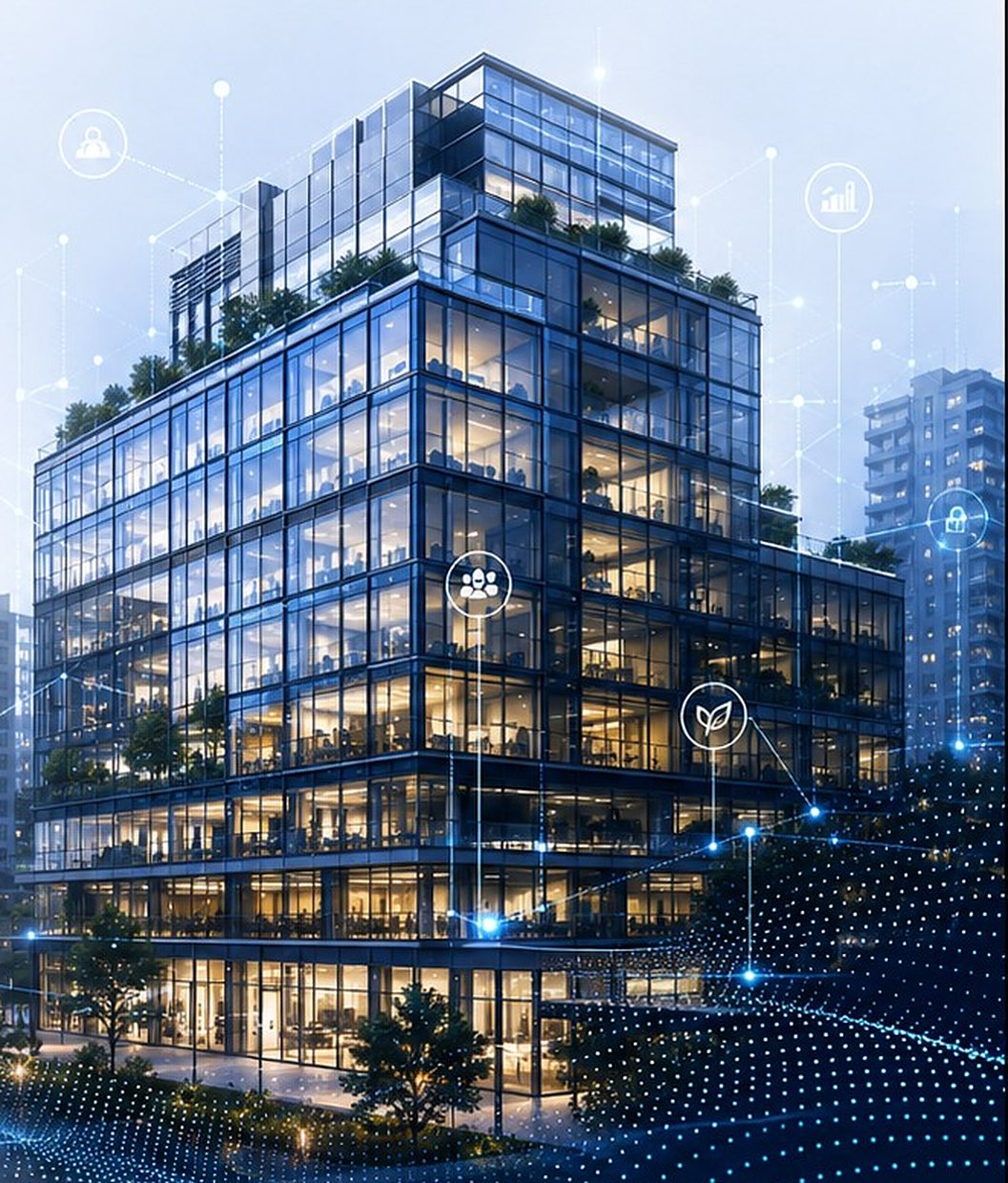
Buildings are no longer just physical assets.
They generate data, host services, drive performance and create value across their lifecycle. Smart Building Evolution helps transform this complexity into measurable business outcomes.
Your buildings already generate their data. The BOS gives them shared intelligence.
Modern buildings rely on many digital systems. Each one captures valuable information – but when data is not organised, it loses its meaning and leads to inconsistent insights, management blind spots and suboptimal operations.
- BIM
- BMS / GLT
- CMMS
- IWMS
- EMS
- Occupant apps
- Access control
- Booking
- Process equipment
- Business applications
- Any other OT or IT system

A building does not need to be fully instrumented to be understood.
CMMS preserves interventions and maintenance history, IWMS describes spaces and how they are used, access control logs movement, BIM provides the geometry. Combined, these systems offer a rich view of performance without requiring full re-instrumentation.
Data fragmentation drives hidden costs.
Version silos, duplicated data, inconsistent decisions, incomplete reports: a consumption cannot be reliably identified, a space is considered occupied when it is not. Explaining costs, comparing buildings and validating results becomes difficult.
The BOS brings a structured response.
The Building Operating System connects existing information in a shared and up-to-date digital twin – it does not replace existing systems, it connects them. Your systems remain in place and continue to operate.
The BOS transforms scattered data into clearer information, smarter decisions and measurable results.
Isolated data
BMS, metering, CCTV, EMS, CRM, access control, reservations, occupant apps, IoT …
Single source of truth
Linked, contextualised and historical data
Correlation, AI & automation
Sequencing rules, analytics and decision support
Services & applications
Control dashboards, digital twin, maintenance, reporting, user services
Value & ROI
Smarter decisions, productivity, comfort and lower operating costs
A better deal for everyone who owns, operates and uses buildings.
Owners & property managers
Understand, optimise and enhance asset value: consolidated view, CAPEX optimisation, ESG reporting.
Learn moreOperators & maintainers
Diagnose faster, intervene at the right place and prevent recurrences.
Learn moreOccupants & employees
Work better, easy access to services, more comfort.
Learn moreEnergy & carbon
Understand, reduce and decarbonise consumption – and measure results.
Learn moreExamples of real business impact
Indicative values from projects and scenarios – actual impact depends on the building, its use and the deployment scope.
energy consumption on average
time to resolve incidents
asset value through better decisions
€30,000 per year
A measured 10 % saving on 2 GWh per year = 200 MWh avoided – at €0.15 per kWh.
€250,000 opportunity
1,000 m² of underused space at a total occupancy cost of €250 per m² per year.
Over 9,000 hours
500 occupants each saving five minutes per day – over 220 working days a year.
Illustrative examples – to be confirmed based on the building, its uses and the deployment scope.
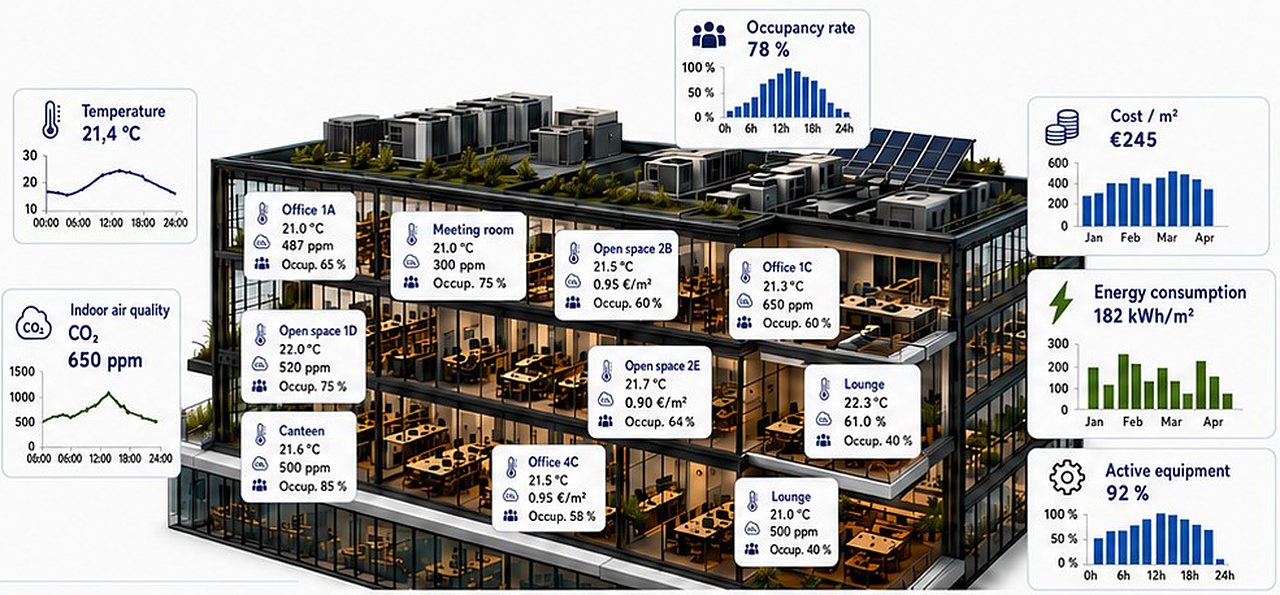
A live representation of the building – and everything that happens in it.
The digital twin links spaces, equipment, usage data and real-time events to give secure access to continuous operational oversight.
- Temperature, air quality (CO₂) and occupancy per room
- Energy consumption, cost per m² and equipment status
- Context instead of raw data: equipment, zone, time and events linked
Key benefits to retain
Energy savings & decarbonisation
Improved operational efficiency
Better decisions & lower CAPEX
Improved comfort & well-being
Time savings & productivity
Comfort & quality of service
Start focused, prove value quickly, then scale with confidence.
- 01
Discover & prioritize
Confirm objectives, pain points and existing systems.
- 02
Frame the first use case
Define users, data, KPIs and expected value.
- 03
Deploy foundation + first app
Connect priority data sources and deliver a first operational service.
- 04
Scale and expand
Add more applications, sites, services and analytics over time.
Let’s talk about your building.
In a 60–90 minute workshop we clarify priorities, available data and the first practical use case – with no obligation.